
Building an AI-Powered Decision Support System for a National Home and Appliance Retailer
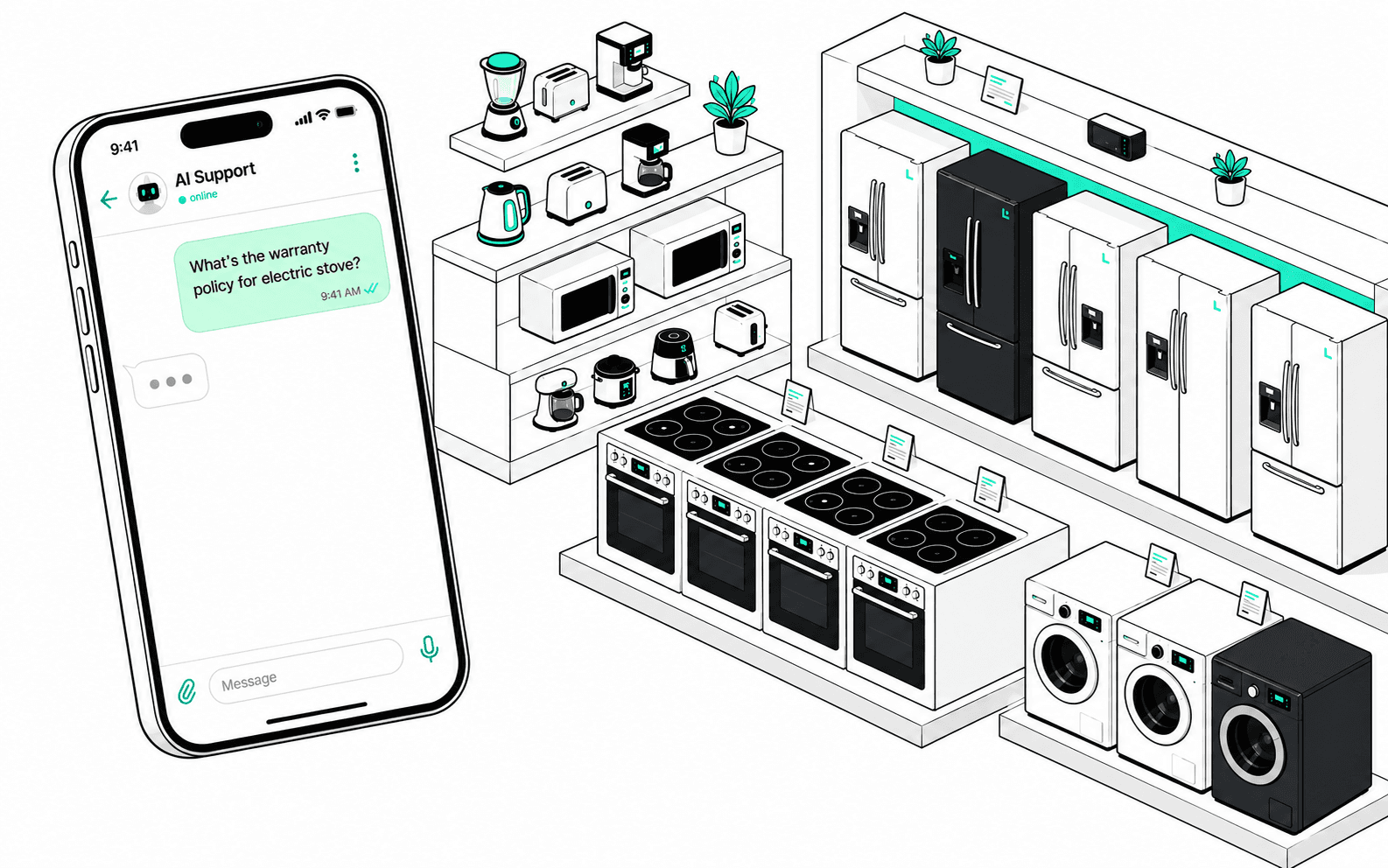
Transforming fragmented enterprise knowledge into faster, more consistent business decisions
A well known national home and appliance retailer in the Philippines partnered with SOFI AI to solve a growing operational challenge. Where its employees had access to large volumes of business information, but finding the right answer at the right time was difficult. Critical knowledge was spread across departments, OneDrive folders, spreadsheets, policies, sales reports, and internal systems. Employees often relied on manual searches, manager consultations, and document reviews to answer routine questions. As a result, these caused slowed decision-making, created inconsistent interpretations, and limited visibility across the organization. SOFI AI designed and deployed a secure, multilingual AI decision support system that gave authorized employees a simpler way to access trusted company knowledge. Through a conversational interface, users could ask questions in English, Tagalog, or Taglish and receive clear answers from approved internal sources. The solution created a more scalable approach to enterprise knowledge management. It reduced search friction, improved consistency, and helped teams make faster, better-informed decisions while keeping people in control of high-impact actions.
The Business Challenge
The retailer’s information environment had grown organically. Over the years, different teams stored documents in different formats and locations, often using separate naming conventions, reporting structures, and processes. As a result, employees had to know where information lived before they could begin searching. Similar questions could receive different answers depending on who was asked, and managers or subject matter experts became bottlenecks for routine requests. The company also needed an interface that should work for its diverse workforce with different roles, language preferences, and levels of technical confidence. Traditional document repositories and dashboards were useful, but they were not always intuitive for frontline workers. The retailer needed an enterprise AI solution that could connect trusted knowledge, understand business context, respect access permissions, integrate with existing systems, and provide useful answers through a simple chat experience.
The Solution & User Experience
AI Discovery.
SOFI AI began with a structured discovery process to identify how teams searched for information, where delays occurred, and which high-value decisions would benefit from faster access to trusted data.
Custom AI Integrations.
The platform connected approved sources such as OneDrive folders, spreadsheets, internal documents, policies, and operational reports. Content was organized and indexed so the AI could retrieve relevant information while preserving existing permissions and security rules.
24/7 Multilingual AI Support.
Employees could ask natural-language questions in English, Tagalog, or Taglish, and the AI would retrieve trusted company information, provide clear responses with supporting sources when available, or indicate uncertainty and request clarification or escalate to a human expert when needed.
Workflow automation.
SOFI AI identified repetitive work that could be simplified or automated, including recurring information searches, report summaries, policy lookups, and common operational questions.
Responsible AI by Design
The decision support system was built for enterprise use. It features role-based access control (RBAC), approved data connections, permission-aware retrieval, response grounding, logging, and escalation paths helped protect proprietary information and reduce unsupported answers. Human oversight remained central. High-impact decisions still required appropriate review, and the system was designed to communicate uncertainty rather than present every response as definitive. This approach allowed the retailer to improve access to knowledge without compromising governance. It also created a stronger foundation for future AI use cases, including performance monitoring, predictive analytics, customer support enablement, and additional workflow automation.
Business Impact
Faster Access to Trusted Knowledge
Teams spent less time searching across disconnected folders, spreadsheets, and systems. Employees could begin with one conversational interface and receive relevant business context more quickly.
More Consistent Decisions
By grounding responses in approved policies and internal data, the platform helped reduce conflicting interpretations across departments, roles, and locations.
Better Management Visibility
Managers could access relevant operational context without waiting for repeated manual searches, report preparation, or follow-up from multiple teams.
Scalable Knowledge Access
The retailer established a repeatable way to make enterprise information available across departments and language preferences while preserving role-based permissions.
Improved Employee Experience
Natural-language interaction made business information easier to access for users with different levels of technical expertise.
A Foundation for Enterprise AI
Rather than treating AI as a standalone experiment, the retailer implemented a practical capability connected to everyday operations and future automation opportunities.
Why AI Decision Support Matters in Retail?
Home and appliance retailers operate in a fast-moving environment shaped by seasonal demand, promotions, inventory availability, supplier performance, customer expectations, and regional market conditions. When operational knowledge is fragmented, teams lose time and decisions become harder to standardize. An AI-powered decision support system closes that gap by turning distributed information into accessible, context-aware guidance. For this case study, the value of AI came from making existing knowledge more usable not from replacing the people who understand the business.
Frequently Asked Questions
SOFI AI is a solutions provider that helps organizations connect, organize, and use internal knowledge. For retailers, it can support conversational search, decision support, workflow automation, operational analytics, and secure employee access to approved information.
It reduces the time required to collect, review, and summarize information from multiple sources. Managers can ask direct questions, receive relevant context, and identify issues faster while retaining responsibility for final decisions.
Depending on permissions and system design, the platform can work with policies, procedures, spreadsheets, sales reports, operational documents, product information, inventory data, and other approved internal sources.
No advanced technical training is required for everyday users. The system is designed around natural-language questions and an intuitive interface. Administrators may receive additional training for governance, source management, and workflow configuration.
Yes, when current and relevant data is available. It can help teams compare trends, surface anomalies, and identify factors that may require attention. Predictive recommendations should still be validated against business context and human expertise.
The platform uses role-based access, authentication, permission-aware retrieval, approved data connections, logging, and governance controls. The exact security architecture is configured around the client’s technology environment and compliance requirements.
Any AI system can produce incomplete or incorrect output. SOFI AI reduces this risk through source grounding, uncertainty handling, access controls, verification patterns, and human escalation. High-impact decisions should always include appropriate review.